Tattoo Artist Year One Survival Guide
Year one usually fails on business systems, not tattoo skill. This guide covers the client flow, money discipline, and operating habits that keep a new studio alive.

The Year That Breaks Most Artists

The tattoo industry has a brutal first year. Not because the work is hard — you presumably already know how to tattoo. The hard part is everything else: building a client base from nothing, figuring out the business side while doing the creative work, managing money when income is inconsistent, and navigating the loneliness of being self-employed.
Most advice for new tattoo artists focuses on the craft: how to improve your linework, how to build a portfolio, how to find an apprenticeship. This guide is about what happens after you open your doors.
Year one is about survival. Everything else comes later.
The Portfolio Before the Business
Before you open — before you set up your booking page, before you hang your shingle — you need a portfolio that actually books clients. Not the work you did in your apprenticeship. Not the practice skins. Real tattoos on real people.
How many pieces do you need? There's no magic number, but 15-20 strong, cohesive pieces in your target style is the minimum for a booking page that converts. Cohesive matters more than large. A portfolio of 20 pieces in 10 different styles signals that you don't have a specialty. A portfolio of 15 pieces in 1-2 styles signals that you know what you're good at.
Where do you get year-one clients when you have no portfolio? Free or heavily discounted work for friends, word-of-mouth referrals from other artists, and flash days. The goal is to build a portfolio that represents what you want to be booking — not whatever comes through the door.
The Licensing Reality

Tattoo licensing requirements vary by state, city, and sometimes county. Before you book a single client, you need to know:
What licenses do you need? Most jurisdictions require: a tattoo artist license, a business license, and health department approval (sometimes called a "body art facility permit"). Some cities require a zoned commercial space; a home studio may not qualify.
How long does it take? Some cities process tattoo licenses in 2-4 weeks. Others take 3-6 months. Plan for the longest timeline in your area and work backward. If it takes 4 months to get licensed, that's 4 months of not being able to book clients from your new studio.
What's the renewal cycle? Annual? Biennial? Some licenses renew on a calendar year; others on the date you originally applied. Mark renewal dates 60 days before they expire — many artists lose their license status without realizing it because they missed a renewal window.
What insurance do you need? General liability insurance for your studio is non-negotiable. Artist liability (E&O) insurance covers you if a client claims your work caused injury or infection. Providers like Philadelphia Insurance and Artineers specialize in tattoo artist coverage. Cost: typically $300-$800/year for a solo artist.
The Money Math Nobody Does
Most new tattoo artists don't do the money math before they open. This is a mistake.
Fixed costs (monthly):
- Booth rent or studio mortgage
- Utilities (electricity, internet, HVAC)
- Licensing and insurance
- Booking/payment software (LVL2 or similar)
- Supplies (ink, gloves, barriers, etc.)
Variable costs (per client):
- Disposable supplies per session (gloves, barriers, ink caps, etc.)
- Card processing fees (if taking card payments)
- Touch-up costs if needed
Revenue math:
- If your average session is $200 and takes 2 hours, your hourly rate is $100
- If you book 15 sessions/month, your gross revenue is $3,000
- After fixed costs (~$800-1,500/month for a basic studio setup), your net is $1,500-2,200
- That's $18,000-26,400/year — before taxes, before equipment replacement, before health insurance
The math is sobering. Most tattoo artists don't make real money until year 2-3, when their client base is established enough to fill their calendar consistently.
What this means for year one:
- Keep your day job if you have one, or have 6-12 months of expenses saved before you open
- Don't turn down work in year one — build the book before you specialize
- Track every expense. Tax season will be less painful if you have records.
Building the Book: Year One Client Acquisition
Year one client acquisition is the hardest part. You have no reputation, no reviews, no word-of-mouth yet. Here's what actually works:
Flash days. Flash days are the best year-one client acquisition tool. Fixed-price flash pieces ($100-200) with no customization required. Clients know what they're getting. You know exactly what you're doing. High volume, fast turnaround, portfolio building, and cash flow. Do 2-3 flash days in your first 6 months.
Social consistency. Post your work 4-5x per week. Not just finished pieces — process content (stencil to healed), client testimonials, your studio setup. The algorithm rewards consistency. Show up every time the algorithm expects you to show up.
Client referral incentive. After every session, ask: "Do you know anyone who'd be a good fit for my work?" Have a simple referral mechanic — "Refer a friend and get $20 off your next session" — that makes it easy for happy clients to send people your way.
Collaborate with adjacent artists. Find artists whose work complements yours but doesn't compete directly. A blackwork artist can refer clients who want color work to a color specialist, and vice versa.
The Emotional Reality of Year One
Nobody talks about this enough: year one is lonely, financially stressful, and professionally uncertain in ways that can break you if you're not prepared for them.
The feast and famine cycle. Some months you'll be fully booked. Others you'll have 3 clients. This is normal for year one. The goal is to build enough pipeline that the famine months get shorter and less severe over time.
The comparison trap. Instagram shows you everyone else's highlight reels. The fully-booked artists, the convention appearances, the magazine features. Most of them took 5-10 years to get there. Year one is not the time for comparison. Compare yourself to yourself — last month vs. this month, last quarter vs. this quarter.
The client relationship learning curve. Not every client is a good client. Some will haggle, some will no-show, some will bring you designs that aren't right for your portfolio and get upset when you say no. Learning to say no to bad-fit work is one of the most important skills in year one. Bad-fit clients take more time, pay less, and produce work that doesn't represent what you want to be known for.
The craft vs. business tension. You became a tattoo artist to do creative work. Year one will make you realize that tattooing is also a small business. Booking, invoicing, inventory, licensing, accounting — these are not optional. The artists who survive year one are the ones who build systems for the business parts rather than trying to manage everything by memory and instinct.
The Systems You Need From Day One
You don't need to be a software expert. You need three basic systems:
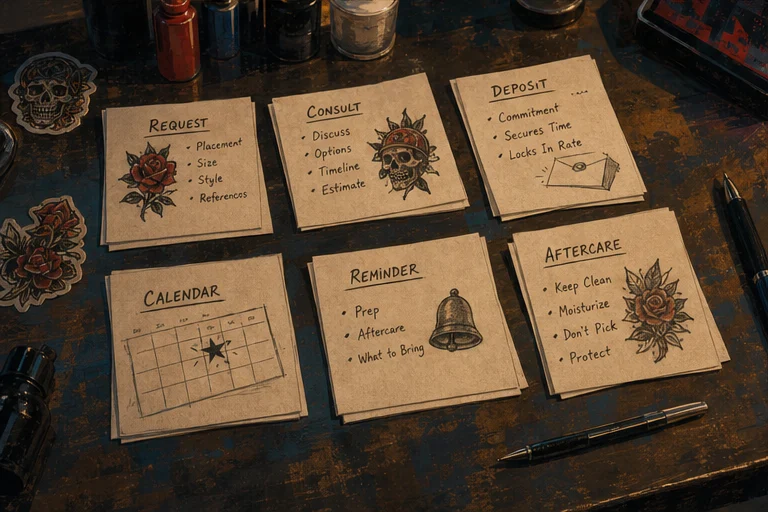
A booking system. Online booking page — LVL2 or similar — so clients can see your availability and book without you being involved in every step. Every inquiry that requires a back-and-forth conversation is an inquiry that doesn't convert.
A deposit and payment system. Collect deposits at booking. Track payments in one place. Have a clear cancellation/no-show policy and enforce it. The artists who lose the least to no-shows are the ones who had a clear policy from day one and communicated it before the appointment.
A client record system. Who have you tattooed? What did you do? What did they say about aftercare? LVL2's client profiles store this automatically. If you're using a paper book or your text messages as your client record, you're creating a problem for yourself 2 years from now when a client comes back for a touch-up and you have no record of what you did.
The One Thing That Determines Year-One Survival
If there's one variable that predicts whether a new tattoo artist survives year one, it's this: whether they treat it like a business from day one.
Not after they have enough clients. Not after they "figure things out." From day one.
That means: having a booking system before you open. Having a deposit policy before you take your first appointment. Tracking your income and expenses from month one. Filing your taxes quarterly instead of annually. Building systems for the administrative work instead of managing everything by feel.
The artists who fail year one don't usually fail because they're bad tattoo artists. They fail because they ran out of money, didn't have systems to manage the business side, and couldn't sustain the income long enough to build the client base they needed.
The artists who survive year one are the ones who got serious about the business parts before they had to.
Build the operating layer before the panic hits
LVL2 is built for artists who need booking, client records, and day-to-day structure without bolting together generic tools.
See LVL2 for tattoo artistsKeep payment assumptions conservative while processor work is still in transition.